


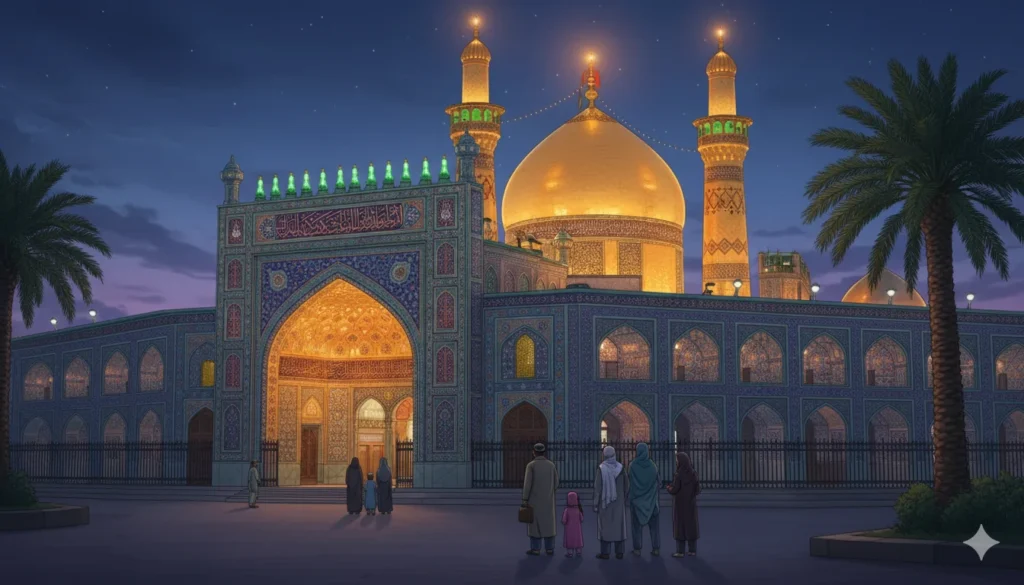
Today, on the 21st of Ramadan 1447 AH, millions of Muslims across Pakistan and around the world observe Youm-e-Ali — the annual day of mourning that marks the martyrdom of Hazrat Ali ibn Abi Talib (RA), one of the most revered figures in Islamic history. From the crowded streets of Karachi to the mosques of Lahore, Peshawar, and Islamabad, the day is marked with processions, prayers, and quiet reflection.
Youm-e-Ali is observed every year on the 21st of Ramadan to commemorate the martyrdom of Hazrat Ali ibn Abi Talib (RA), the fourth Caliph of Islam. This year, that date falls on Wednesday, March 11, 2026.
Who Was Hazrat Ali (RA)?
Hazrat Ali ibn Abi Talib was born in Mecca around 600 CE inside the Kaaba — a birth so rare that it has been cited across centuries as a sign of his extraordinary spiritual station. He was the cousin and son-in-law of the Prophet Muhammad (PBUH), and among the first people to accept Islam, having done so as a young boy.
He served as the fourth Caliph of Islam from 656 to 661 CE, a period of significant political upheaval in the early Muslim world. For Sunni Muslims, he is among the most honored of the Rightly Guided Caliphs. For Shia Muslims, he holds the highest authority as the first divinely appointed Imam — a distinction that lies at the heart of one of Islam’s oldest theological divisions.
Hazrat Ali is remembered not only as a warrior and statesman but as a scholar, poet, and jurist whose sayings — compiled in the Nahj al-Balagha — continue to be studied and cited across the Islamic world to this day. His words on justice, governance, and the human soul remain as relevant in contemporary discourse as they were fourteen centuries ago.
The Martyrdom: What Happened on 21st Ramadan
A poison-coated sword struck Hazrat Ali during prayer in Kufa’s Great Mosque on the 19th of Ramadan. He passed away on the 21st of Ramadan. The assassin, Abd al-Rahman ibn Muljam, was a member of the Kharijites — a group that had broken away from Ali’s camp during the arbitration following the Battle of Siffin. His death in 661 CE marked the end of an era and deepened the division between what would become Sunni and Shia Islam.
He was 63 years old. His final resting place is the Imam Ali Mosque in Najaf, Iraq — one of the holiest sites in the Islamic world and visited by millions of pilgrims each year.
How Pakistan Observes Youm-e-Ali in 2026
The Sindh government announced a public holiday for schools and colleges on March 11, 2026, in observance of Youm-e-Ali. All public and private educational institutions across Sindh remain closed on Wednesday. Government offices and banks continue to operate normally.
In Karachi, the country’s largest city and commercial capital, the central juloos follows its traditional path — starting from Nishtar Park around 1:00 PM after the central majlis, moving to Numaish Chowrangi, proceeding along M.A. Jinnah Road, and ending at Hussainia Iranian Imambargah in Kharadar by late evening.
Security this year is extensive. Sindh has deployed over 22,000 police personnel province-wide, with about 7,900 in Karachi alone. Snipers are positioned on high-rise buildings, more than 1,000 CCTV cameras monitor the procession route, and a three-layer security perimeter surrounds the main juloos. Walk-through gates and manual frisking are mandatory, and pillion riding faces a temporary ban across Karachi for a 24-hour period.
At the federal level, Federal Interior Minister Mohsin Naqvi met with prominent Shia scholars in Islamabad to discuss arrangements for religious gatherings during Ramadan. Both sides reached an understanding that processions held on 21 Ramadan will conclude by the time of Maghrib prayers throughout the country — a measure designed to ease security management and ensure participants break their fasts safely.
Sindh Chief Minister Murad Ali Shah chaired a high-level review meeting to evaluate preparations, directing law enforcement agencies to implement strict security measures, particularly along procession routes and at gathering points.
Youm-e-Ali and Ramadan 2026
Ramadan 1447 AH began in Pakistan on the evening of February 19, 2026. The holy month — observed by more than 1.8 billion Muslims worldwide through fasting, extended prayer, and charitable giving — reaches one of its most spiritually charged moments during its final ten days, a period Muslims refer to as the Ashra-e-Akhir. The 21st of Ramadan falls within this sacred stretch.
For many Muslims, the coincidence of Youm-e-Ali with the last ten nights of Ramadan — which are believed to include Laylat al-Qadr, the Night of Power — gives the day a compounded spiritual weight. Mosques and imambargahs across Pakistan hold all-night programs, combining Quranic recitation and prayers for forgiveness with elegies mourning the loss of Hazrat Ali.
A Day That Belongs to All Muslims
While Youm-e-Ali carries particular significance in Shia tradition, the reverence for Hazrat Ali (RA) crosses sectarian lines across the Muslim world. His courage in battle, his commitment to justice, and his deep knowledge of Islamic law are qualities that Sunni scholars and institutions have honored throughout history. On this day, that shared reverence brings communities together.
As processions move through the streets of Karachi, Lahore, Multan, and dozens of other cities today, they carry with them fourteen centuries of memory — of a man who shaped the course of Islamic civilization and whose legacy continues to be felt in every corner of the Muslim world.
Sources: Daily Pakistan, Hamariweb, Daily Ausaf, Minute Mirror, Momentum Pakistan — reporting current as of March 11, 2026.